
Getting to Know These Plants

Ten common, easy-to-identify edible plants found in built and growing zones across Suomi.

Stinging nettle plant

Stinging Nettle — Nokkonen

Nettle. Opposite, toothed, heart-shaped leaves covered
in fine stinging hairs. Square stem. Grows in dense patches,
often in nitrogen-rich, disturbed ground.

Wear gloves or pick carefully — see section 1.4 for the case
for and against gloves. Young spring leaves are the most tender
for eating; cooking neutralises the sting completely.
Dandelion plant

Dandelion — Voikukka

Dandelion. Deeply toothed leaves in a low rosette,
hollow stem, single bright yellow flower head that becomes
the familiar seed clock.

Every part is edible — leaves, flower, and root.
Leaves are best young and slightly bitter; root can be roasted
as a coffee substitute.

Plantain plant

Plantain — Piharatamo

Plantain. Broad oval leaves
with prominent parallel veins, growing in a low rosette,
extremely common in compacted ground — paths, pavements, lawns.

Young leaves are edible, slightly bitter and fibrous when older.
Also has a long history of topical use for stings and minor cuts.

Fireweed plant

Fireweed — Maitohorsma

Fireweed. Tall, upright stems with narrow,
willow-like leaves and tall spikes of pink-purple flowers.
Common on disturbed ground, forest clearings, and roadsides.

Young shoots in spring snap cleanly when ready to eat —
see section 1.4 on why that snap matters more than a knife cut.
Pairs beautifully with fiddlehead fern.

Fiddlehead fern shoots

Fiddlehead Fern — Kotkansiipi

Fiddlehead — ostrich fern. The tightly coiled
young shoots emerge in early spring before unfurling into
mature fronds. Only this Nordic species is considered
reliably safe to eat; many other fern shoots are not.

Harvest only the tightly coiled, unopened shoots, and always
cook thoroughly before eating.

Ground elder plant

Ground Elder — Vuohenputki

Ground Elder. Compound leaves in groups of three,
each leaflet toothed and pointed, on a hollow, ridged stem.
Spreads vigorously in shaded garden and woodland-edge settings —
considered invasive in many gardens, which makes it a guilt-free harvest.

Young leaves before flowering are the most tender and mild,
tasting somewhat like a cross between parsley and celery.

Chickweed plant

Chickweed — Pihatähtimö

Chickweed. Small, soft, oval leaves on weak, sprawling
stems, with tiny white star-shaped flowers. Grows almost
year-round in gardens, disturbed soil, and shaded urban corners.

Mild, slightly grassy flavour, good raw in salads.
One of the most forgiving plants for beginners to learn first.

Lambsquarters plant

Lambsquarters — Jauhosavikka

Lambsquarters. Diamond-shaped leaves with a distinctive
pale, slightly mealy or dusty coating, especially on new growth.
Grows tall and upright in disturbed, nutrient-rich ground.

Contains oxalic acid, similar to spinach — best cooked rather
than eaten raw in large quantities, especially if you eat it often.

White and red clover

Clover — Apila / Puna-apila

White Clover and Red Clover. Both have the familiar three-leaflet leaves
and rounded flower heads — white clover low and creeping,
red clover taller and upright. Common in lawns and meadows everywhere.

Flowers and young leaves are both edible, often used in teas
and as a mild, slightly sweet salad addition.

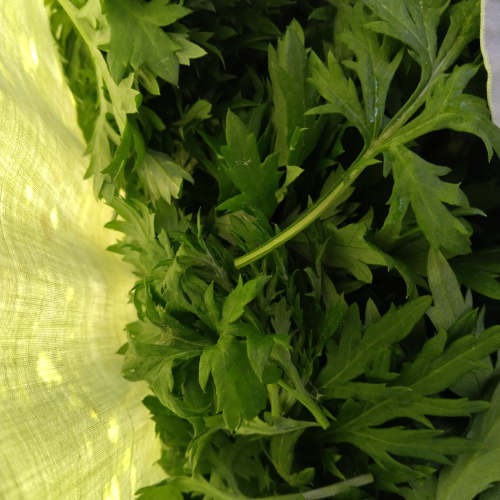
Mugwort plant

Mugwort — Pujo

Mugwort. Deeply lobed, feathery leaves, silvery-grey
and downy on the underside, with a strong, distinctive sagebrush-like
smell when crushed. Grows tall along roadsides, waste ground, and edges.

Used historically as a culinary herb and in traditional practices
across many cultures. Strong flavour — used sparingly rather
than as a primary green.

A wider meadow with many plant species

More to Come

This list of ten is a starting point, not a ceiling.
Lady's mantle, garlic mustard, burdock, wood sorrel, yarrow,
sweet cicely, ramsons, sea buckthorn, and rowan are all
candidates for a later, expanded section.